
Worked case: a 4,000-square-foot warehouse unit in Yosemite Business Park, aisles striped and the work phased — what happens and what it costs
Epoxy Floors Field Clovis walks through a typical job for a 4,000-square-foot warehouse unit in an older multi-tenant industrial complex: a worn but sound slab of decades, gritted solid-color epoxy, painted aisle lines, landlord consent and the work phased so the dock door stays usable.
Bookings aren't open yet. Leave your name and number; your message is recorded, and you'll get one message when a local installer is available.
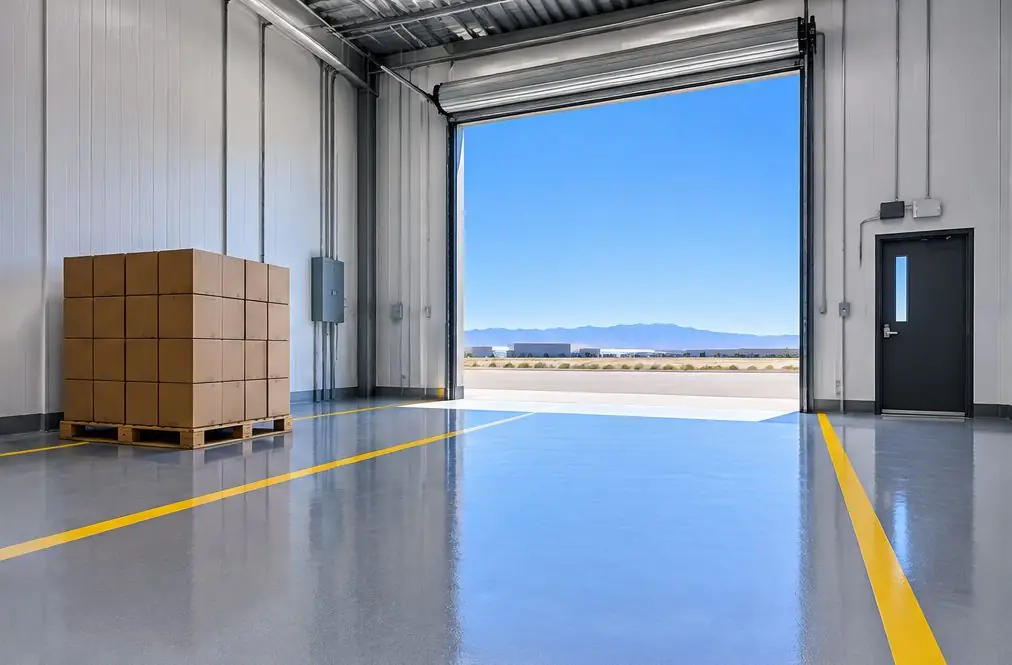
Worked example. The pictures are AI concept illustrations, not photographs; no installation was performed or arranged through this site; prices are typical Clovis area market ranges, not quotes.
 Illustration
Project Examples & Typical Prices
The scenario
Picture a unit of about 4,000 square feet in a multi-tenant industrial complex built in the 1980s near the airport, with a small office up front, racking along both side walls and a roll-up dock door at the back. The tenant stores and ships parts. The slab is many years old, sound under the dust, with saw cuts that are open but not broken, and it shows the polish of years of pallet jack wheels. No old coating is left on it.
The tenant wants an easy-to-sweep surface that accepts aisle lines and a dock-door lane. Its lease says that the landlord must consent in writing to changes in the premises, and the tenant obtains that consent. Shipping cannot stop, so the work is split into zones and phased.
The starting conditions at a glance:
- Size: about 4,000 square feet of slab-on-grade
- Slab: sound but worn, open saw cuts, no old coating
- System: solid-color epoxy with grit in the top coat and painted aisle lines
- Schedule: phased, one zone at a time, with the dock lane kept for last
What the job involves
- The tenant and the installer mark four zones on a drawing, number the aisles and set the order: the back wall first, the dock lane last.
- Pallets move from the zone being coated into the finished zone on the day after it is ready for foot traffic, at the time set by the data sheet.
- A planetary grinder tied to an industrial vacuum polishes down the worn surface and opens the pores; an edge grinder works the walls and the racking bases.
- A moisture reading in the first zone confirms the slab is within the primer's limit.
- Primer and the epoxy are rolled in strips from the back; the clear grit coat follows, and the saw cuts are left open for a separate step if the tenant chooses to fill them.
- Once the data-sheet cure time has passed, the lanes are chalked out, the stripes are taped and painted, and the stock goes back in.
Materials and prep
- Planetary grinder, edge grinder and a high-capacity dust extractor
- Epoxy primer, pigmented epoxy and a clear gritted top coat
- Squeegees with notched blades, roller frames, spiked shoes and fans
- Line paint, tape, a chalk reel and a measuring wheel for the aisle layout
- Slab thermometer and a moisture kit
What it typically costs in the Clovis area
| Solid-color epoxy with grit, 4,000 square feet installed ($3–$7 per sq ft) | $12,000–$28,000 |
| Line striping and safety markings | +$300–$900 |
| Typical total | $12,300–$28,900 (market range, not a quote) |
These are typical local ranges, not a quote or an offer; an installer prices the actual job after seeing the floor.
Add-ons often paired with this job
- Joint filling (saw cuts and control joints) — +$400–$1,200. Open saw cuts can be filled with a semi-rigid material so wheels stop chipping the edges.
- Cove base up to 100 linear feet — +$1,500–$2,500. A coved base along the walls of the office zone adds a finished edge.
Why it is done this way
Gritted solid-color epoxy is the base system for aisles with pallet jacks and a light stacker. At $3–$7 per square foot it seals the dust, takes stripes and costs less than the decorative systems. On a sound slab there is no repair line, so the entire cost sits in the per-square-foot range: $12,000–$28,000 for 4,000 square feet, and with the striping line of $300–$900 the total is $12,300–$28,900.
Most of the spread between low and high is the thickness of the build and the grind. A thin film suits light traffic; if hard-wheeled lifts pivot in the same spots, quartz broadcast at $8–$15 per square foot is worth a look.
Phasing keeps the business running: with the unit worked zone by zone, the dock stays usable on most days. The schedule flag in the estimator is only a note for the contractor and leaves the range unchanged. When foot traffic, carts and forklifts may return depends on the system, the temperature and the humidity, so the data sheet decides.
Heat adds a planning constraint. A closed metal-roofed unit in a summer with a mean high of 97°F runs hotter than the air outside, so large pours start at first light and the doors are managed to move air.
The alternatives that were weighed and set aside:
- Polished concrete densifies the slab and controls dust, but oil and striping behave differently on it.
- A penetrating sealer costs less and wears faster under wheels.
What would change the price
- Oil under the racking or a damp reading brings in the line of $2–$5 per square foot.
- Cracks or chipped saw cuts add the repair line of $1–$3 per square foot.
- A leftover coating or adhesive has to come off before this range applies.
- Racks that cannot be emptied stretch the number of phases.
- Hard-wheeled lift trucks that pivot in one place make quartz broadcast the better fit.
Where this leads
- Service page: Warehouse Floor Coating — Aisle, dock and joint planning for warehouse and light-industrial floors in Clovis, with a sample budget and a section on valley heat at the door.
- Local page: Epoxy garage floors in Yosemite Business Park
- All services and typical prices: epoxy garage floors in Clovis
- More worked examples: Project Examples & Typical Prices
Check availability and the price range for this setup
Bookings aren't open yet — a typical Clovis range in about 30 seconds.