
Commercial Epoxy Flooring in Clovis
Epoxy Floors Field Clovis covers commercial epoxy and resinous floors in Clovis — warehouse aisles, restaurant kitchens, repair bays, storefronts, gyms and private clinics — from the restored blocks of Old Town to the retail district around Sierra Vista Mall and the business parks along Herndon Avenue and the Highway 168 corridor, with a system matched to each room and the closure time planned before the first quote.

Bookings aren't open yet. Leave your name and number; your message is recorded, and you'll get one message when a local installer is available.
 Illustration
One building, several floors
Most commercial buildings contain three or four different floors hidden inside one lease. A restaurant has a hot kitchen, a dry pantry and a dining room; a shop has a customer counter and a service area; a warehouse unit has a dock apron, aisles and a break room. The system is chosen for what punishes each room most, not for the business name on the door.
| Room or zone | What punishes it | System a contractor might propose | Estimator range per sq ft |
|---|---|---|---|
| Storefront sales floor | Foot traffic, grit from the sidewalk, window glare | Decorative flake | $6–$12 |
| Back room and storage | Hand carts, boxes, damp mops | Solid-color epoxy with grit | $3–$7 |
| Shop bay or service area | Fluids, tires, point loads | Solid epoxy with grit, quartz where wheels turn | $3–$15 |
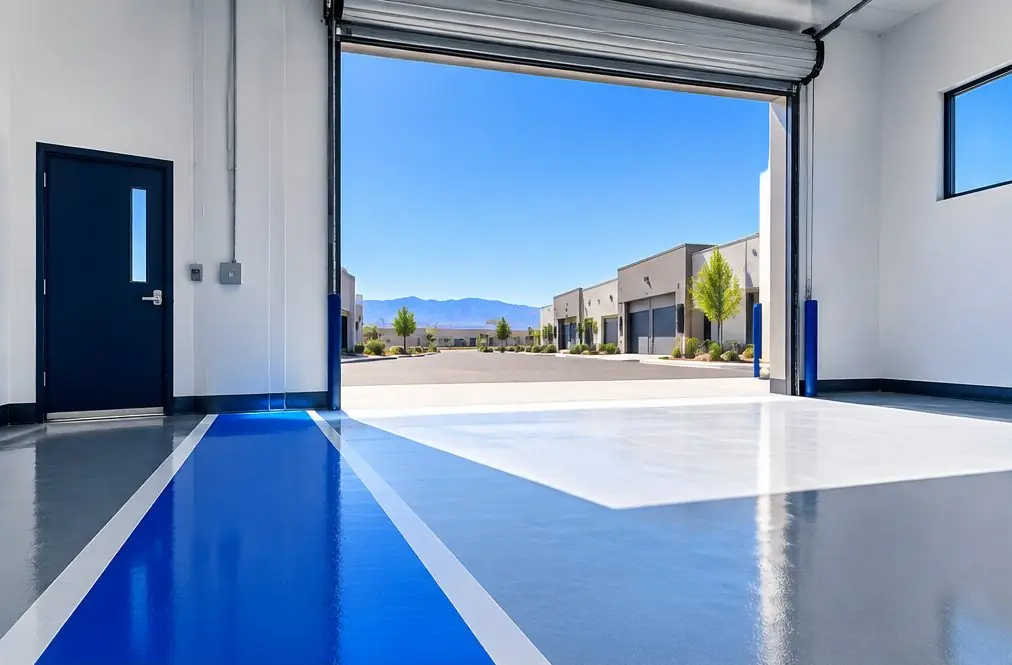
| Roll-up door apron | Sun on the slab, wheel impact, tracked-in grit | Quartz-filled broadcast | $8–$15 |
| Kitchen cooking and dish line | Hot water, grease, thermal shock | Urethane cement | $10–$18 |
These are market estimates from published commercial price pages. A real quote can fall outside them, and the business path of the estimator layers slab condition and flat options on top.
Three sample budgets for common space sizes
All three are hypothetical; none describes a real business or building. The arithmetic is rate per square foot times area, with the slab surcharge added to the rate first.
| Scenario (hypothetical) | Rate per sq ft | Area | Total |
|---|---|---|---|
| Older storefront suite, decorative flake, cracks and joints to repair | $7–$15 ($6–$12 plus $1–$3) | 1,800 sq ft | $12,600–$27,000 |
| Light-industrial unit, solid epoxy with grit, sound slab | $3–$7 | 6,000 sq ft | $18,000–$42,000 |
| Same unit, slab soaked with oil in the service lanes | $5–$12 ($3–$7 plus $2–$5) | 6,000 sq ft | $30,000–$72,000 |
The spread between the last two rows shows why an inspection comes before a number. Units under about 1,000 square feet usually carry a higher rate, because setup and prep spread over less floor. Nothing here is a quote.
What the Clovis map changes
Old Town Clovis is a historic center that was rebuilt around restored storefronts on Clovis Avenue and newer buildings given early 20th-century-style facades. For a floor, that means slabs of unknown age and unknown history under tile, linoleum or paint, and sometimes a patched trench where plumbing was moved. Buildings from before 1980 get tested for asbestos in old mastic and tile before anything is ground.
The retail district around Sierra Vista Mall, a 78-acre enclosed regional shopping center, is where freestanding stores, pad buildings and strip suites face large parking lots and glass fronts. Industrial space is spread across several parks: Dry Creek Business Park north of Herndon Avenue, the Clovis Research & Technology Park near Highway 168, and the Yosemite Business Park on the airport side of town. Each has its own landlord, so the property manager, not this site, decides work hours, shared docks and noise.
Summer sun, dust and doors left open
July in Clovis averages a high of 97°F. A slab beside a glass storefront or a roll-up door warms through the afternoon, and hot air and a hot slab shorten the working time of fast-curing products, so contractors often favor first-light starts for the base coat. Epoxy can amber in sunlight, which matters when the door stays open; aliphatic polyaspartic and polyurethane top coats are generally more UV-stable.
Valley dust blows into any building that opens its doors, and fine grit is the first thing a new floor meets. A sealed floor is easier to sweep and wipe than bare concrete, and texture is a trade-off: more grit adds grip and is harder to clean. A coated floor can be slippery when wet or oily. Broadcast flake and a fine grit added to the top coat add texture and grip; a heavier grit adds more grip and is harder to clean.
A closure plan in four moves
Commercial installs are often scheduled after hours, on weekends or in phases, so part of the floor stays in use. Return to foot traffic, carts and forklifts depends on the system, temperature and humidity and is set by the product's data sheet; fast-cure systems shorten it, and odor and ventilation are planned around occupants.
- Draw the building and shade the rooms that can shut without stopping the business.
- Put the touchiest room where the schedule is loosest: a kitchen or clinic room needs the longest cure before use.
- Take return dates from the data sheet for the named product, and write them in the quote.
- Name who moves what: stock, shelving, equipment, and on which day it goes back.
The schedule choices in the estimator (during business hours, after hours, phased, closed) are flags for the contractor and do not change the range.
Questions worth asking before the walk-through
- Which system is proposed for each room, and why that one?
- How will the slab be ground, and which moisture test is run and read?
- What is under the existing floor, and is anything tested before it is removed?
- How are saw cuts, control joints and cracks treated at the surface?
- What are the return times for foot traffic, carts and forklifts, taken from the data sheet?
- Is a cove base included, to what height, and who finishes the wall behind it?
- Which cleaners and chemicals will touch the floor, and has the chemical-resistance chart been read for them?
- What time of day does the base coat go down, and how is slab temperature checked?
- What written terms cover the work, what do they exclude, and is the prep part of them?
Commercial Epoxy Flooring — common questions
How much does a commercial epoxy floor cost per square foot in Clovis?
Typical ranges are $3–$7 for solid-color epoxy with grit, $6–$12 for decorative flake, $8–$15 for quartz broadcast and $10–$18 for urethane cement. Cracks, old coatings, oil and moisture add per-square-foot surcharges, and small spaces cost more per square foot. These are market estimates, not quotes.
Can a Clovis business stay open while its floor is coated?
Often, in phases, with one zone closed at a time or with work after hours and on weekends. The data sheet decides when foot traffic and carts can return, and the schedule flag in the estimator tells a contractor what the building can allow.
Does this page cover food-processing plants?
No. Clovis sits in an agricultural region, but food-processing and packing facilities that are inspected by federal agencies follow their own regulators. This site covers private commercial floors such as restaurants, shops, showrooms, gyms and clinics.
Commercial Epoxy Flooring: check availability and price range
Bookings aren't open yet — a typical Clovis range in about 30 seconds.