
Worked case: removing an old coating and treating oil and damp spots in a two-car garage near Old Town, then polyaspartic flake — what happens and what it costs
Epoxy Floors Field Clovis walks through a typical job for a two-car garage on an older street near Old Town: a slab of decades with a failing coating and oil from past cars, a damp corner, the film ground off, a primer for the moisture and a polyaspartic flake floor with the stem wall and the steps included.
Bookings aren't open yet. Leave your name and number; your message is recorded, and you'll get one message when a local installer is available.
Worked example. The pictures are AI concept illustrations, not photographs; no installation was performed or arranged through this site; prices are typical Clovis area market ranges, not quotes.
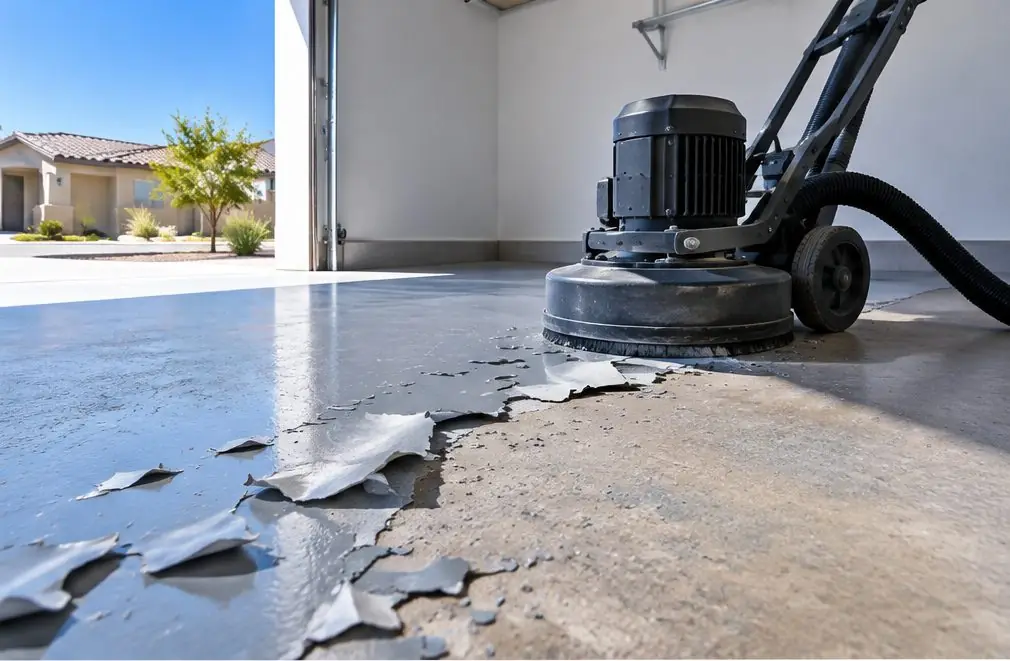 Illustration
Project Examples & Typical Prices
The scenario
Picture a two-car garage of about 400 square feet behind a house on one of the older streets near Old Town Clovis. The slab was poured in the mid-1900s. A previous owner rolled on a coat of gray floor paint that now curls at the door and still clings at the back wall. A dark patch under the old oil leaks stands where a pickup parked for years, and a corner by the water heater feels cool and slightly damp to the hand.
The household wants a flake floor that will take the afternoon sun at the open door without turning amber, which is why a polyaspartic top coat is on the list. The stem wall and the two steps up to the kitchen are bare and chalky, and the wish is to have them finished along with the floor.
The starting conditions at a glance:
- Size: two-car garage, 400 square feet
- Existing floor: gray paint, peeling at the door, a heavy oil patch
- Slab: many decades old, one damp corner, patched cracks from earlier repairs
- System: epoxy base, full flake broadcast and a polyaspartic top coat, stem wall and steps included
What the job involves
- A putty knife slid under the curled edge at the door lifts the paint in strips, which settles the plan: the whole film comes off, nothing is recoated.
- A scarifier takes down the thick spots and a diamond grinder with a vacuum does the rest; the oil patch gets a degreaser, a rinse and a second pass of the grinder, since oil left in the concrete breaks the bond.
- The damp corner is measured with a calcium chloride kit or an in-slab probe; a reading over the primer's limit calls for a moisture-mitigating primer there and possibly across the whole floor.
- Old patches are checked, loose ones are chipped out and refilled, and the cracks are routed and sealed with a flexible filler.
- The epoxy base goes down early in the morning, before the concrete warms; flakes are broadcast to rejection, and the stem wall and both steps are coated with the same stack.
- After the sweeping of loose flake, a polyaspartic top coat is mixed in small batches and rolled fast, because it cures quickly in heat; the data sheet sets the days for feet and for the cars.
Materials and prep
- Scarifier and a diamond grinder, both attached to a dust extractor
- Degreaser, a wet vacuum and a moisture kit
- Moisture-mitigating primer, an epoxy base, vinyl flakes and a polyaspartic top coat
- Flexible crack filler, patch mortar, trowels and a sanding block
- Roller covers, squeegees, spiked shoes, painter's tape and box fans
What it typically costs in the Clovis area
| Polyaspartic flake (epoxy base, polyaspartic top coat), 400 square feet installed ($6–$10 per sq ft) | $2,400–$4,000 |
| Old coating or paint to remove first (+$1–$3 per sq ft) | +$400–$1,200 |
| Heavy oil stains or a slab that tests damp (+$2–$4 per sq ft) | +$800–$1,600 |
| Coat the stem wall (the low wall around the garage) | +$150–$400 |
| Coat the entry steps or landing | +$100–$300 |
| Typical total | $3,850–$7,500 (market range, not a quote) |
These are typical local ranges, not a quote or an offer; an installer prices the actual job after seeing the floor.
Add-ons often paired with this job
- Custom flake blend — +$100–$300. A flake blend chosen to match the kitchen cabinets or the exterior paint is a flat line.
- Move the garage contents out and back — +$150–$400. Clearing shelves and storage before the grind and putting them back later is a flat line the household may do itself.
- Extra crack or joint repair (many cracks) — +$150–$450. Should the older patches reveal a wider network of cracks, a flat extra-crack line pays for it.
Why it is done this way
Removal comes before any choice of flake. A coating bonds only as well as the surface beneath it, and a film that already peels at the door will peel again from under fresh color. The putty-knife test costs nothing and shows which job this is.
Two surcharges stack here, and listing them separately shows where the money goes. Old-coating removal adds $1–$3 per square foot and the oil and damp line adds $2–$4, which lifts the $6–$10 polyaspartic flake base to $9–$17 per square foot over 400 square feet.
The hybrid is chosen for the door. A polyaspartic top coat is generally more UV-stable than epoxy and returns to service sooner, which fits a garage whose open door faces the sun. The epoxy base still does the bonding work to the ground slab.
An older slab often has no vapor barrier under it, so a floor-wide moisture reading, not only the damp corner, belongs in the quote. If the reading is high, the primer step adds cost and time.
The alternatives that were weighed and set aside:
- Painting over the old film skips removal and brings the peeling back.
- Epoxy flake with an epoxy top coat costs $5–$8 per square foot as a base but can amber at the open door.
What would change the price
- A thicker coating than paint, such as an epoxy build, needs scarifying and raises the removal line.
- A reading above the primer's limit across the whole floor, not only the corner, widens the area of the damp-slab line.
- Moving cracks, not static hairlines, call for flexible repair and may show through the finish.
- A single-bay garage of about 240 square feet would cut the area, and with it every line that is priced per square foot.
- A crumbling stem wall has to be repaired before it can be coated.
Where this leads
- Service page: Garage Floor Coating Removal and Recoating — A symptom-to-cause table for failed garage floors in valley heat, the removal methods and what taking off the old coat adds per square foot.
- Local page: Epoxy garage floors in Old Town Clovis
- All services and typical prices: epoxy garage floors in Clovis
- More worked examples: Project Examples & Typical Prices
Check availability and the price range for this setup
Bookings aren't open yet — a typical Clovis range in about 30 seconds.