
Commercial Kitchen Flooring in Clovis
Epoxy Floors Field Clovis covers restaurant and commercial kitchen floors in Clovis — urethane cement where hot water is sprayed, epoxy in dry rooms and a coved base at every wall — including kitchens moving into older Old Town storefronts and the Fresno County plan check that applies to a new or remodeled food space.

Bookings aren't open yet. Leave your name and number; your message is recorded, and you'll get one message when a local installer is available.
 Illustration
What the California rule asks of a kitchen floor
In California, floors in food facilities must be smooth, durable, nonabsorbent and easily cleanable, with a coved base where floor meets wall (California Retail Food Code, Health and Safety Code §114268). The sentence describes a finished floor and does not name a product. No agency lists a floor coating as accepted, so a seller who says one is should be asked where that is written down.
In practice, the question is whether the surface has seams, open pores or crumbling edges where food and water can collect, and whether it can be cleaned the way this kitchen is actually cleaned.
Epoxy, quartz or urethane cement, room by room
Spraying hot water onto a floor heats the surface and then lets it cool, over and over. Standard epoxy can soften and let go under that cycle, so kitchens with spray-down cleaning often use urethane cement, which tolerates heat and thermal shock better. A pantry reached by a mop is a different case.
| Room | What reaches the floor | System a contractor might propose | Estimator range per sq ft |
|---|---|---|---|
| Cooking line | Grease, hot spills, thermal shock | Urethane cement | $10–$18 |
| Dish room | Hot water, detergent, steam | Urethane cement | $10–$18 |
| Prep area | Water, dropped tools | Urethane cement, or quartz-filled epoxy | $8–$18 |
| Walk-in cooler | Cold, condensation | A system rated for the temperature | Quoted per project |
| Dry storage | Carts, boxes | Solid-color epoxy with grit | $3–$7 |
| Dining room | Foot traffic, window light | Decorative flake | $6–$12 |
A coated floor can be slippery when wet or oily. Broadcast flake and a fine grit added to the top coat add texture and grip; a heavier grit adds more grip and is harder to clean.
The cove, and what it costs
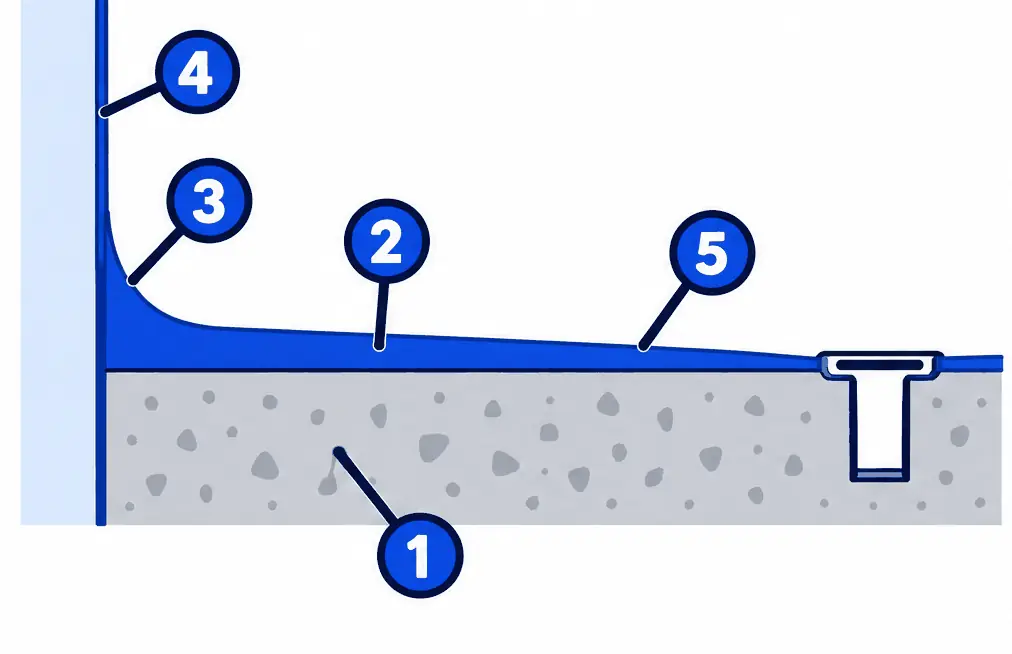
A cove carries the floor up the wall so water and crumbs have no corner to hide in. It is troweled in resin or set from a premade strip, and it can only seal to a wall that is smooth and sound. Drains, floor slope and grease interceptors are plumbing and building work, not coating work.
The estimator prices a cove up to 100 linear feet at $1,500–$2,500. A hypothetical 900-square-foot kitchen in urethane cement on a sound slab costs $9,000–$16,200 at $10–$18 per square foot, and with 100 linear feet of cove the total is $10,500–$18,700. Small kitchens often carry a higher rate.
| Item (hypothetical) | Calculation | Total |
|---|---|---|
| Urethane cement, sound slab | 900 sq ft × $10–$18 | $9,000–$16,200 |
| Cove base | 100 linear feet, flat option | $1,500–$2,500 |
| Kitchen total | $10,500–$18,700 |
What the numbers show
- Concrete slab The surface the whole system bonds to.
- Floor coating A thick seamless layer over the slab.
- Cove A smooth quarter-round curve where floor meets wall, with no gap behind it.
- Wall above the cove The cove stops in a clean straight edge on the wall.
- Slope to the drain The floor falls gently toward the drain so wash water leaves.
A restaurant moving into an older storefront
Old Town Clovis has restored older storefronts with new tenants, and a kitchen going into one usually meets a slab it was not designed for. Older slabs may carry tile, linoleum or mastic that has to be tested and removed, a patched trench from earlier plumbing and low spots that hold water. Buildings from before 1980 are tested for asbestos in old adhesives before grinding starts. A slab that was never meant to be washed may also have a damp patch near a drain line, so moisture is tested where the floor will be coated.
Surface prep is the cost that moves most in these jobs, which is why the estimator carries repair and old-coating surcharges of $1–$3 and $2–$4 per square foot. A landlord or building owner decides work hours and what else can be touched.
The Fresno County plan check, step by step
Clovis sits in Fresno County, and the county's Department of Public Health, Environmental Health reviews plans for new or remodeled food facilities and inspects them. Its Consumer Food Program describes the process: two complete sets of plans are submitted, plans are not received until the plan check fee is paid, and they are reviewed in the order received. The county answers with a correction letter or an approval letter. A back-check needs an appointment, and the reviewed plans stay on the job site until the final inspection. The office is at 1221 Fulton Street, 3rd floor, Fresno, and the phone number is (559) 600-3357.
The page lists no review timeframe, so ask for one. It also lists no finish schedule; the floor details sit in the county's linked Construction Requirements and Construction Checklist documents, which this site could not read. The facility owner or designer submits the plans and the coating contractor delivers what is on them. Ask Environmental Health what finish information a floor change in your space needs, and treat this page as background for that call.
Questions for the contractor and the county
- Is the floor change part of a remodel that needs plan check, and what does the office say?
- Which system goes in which room, and is hot-water washdown assumed in the cooking and dish areas?
- How high does the cove go, and who prepares the wall behind it?
- What moisture test was run on the slab, and what did it read?
- What is the cure and return time from the data sheet, and how is the kitchen ventilated during cure?
- Which cleaning chemicals will the floor meet, and does the chemical-resistance chart cover them?
- What written terms apply, and what do they exclude?
Commercial Kitchen Flooring — common questions
Is epoxy allowed in a Clovis restaurant kitchen?
Epoxy is used in food facilities, especially in dry rooms. The test in California law is a smooth, durable, nonabsorbent, easily cleanable floor with a coved base, not a brand. Many kitchens choose urethane cement for hot-water zones.
Do I need Fresno County review before changing a kitchen floor?
Environmental Health reviews plans for new and remodeled food facilities. Whether a floor change in your space falls under that review is a question for the county office, and it is worth asking before booking work.
Why does urethane cement cost more than epoxy?
It goes down thicker, takes a skilled applicator and has a short working time, so the estimator lists $10–$18 per square foot against $3–$7 for solid epoxy with grit. The extra buys heat tolerance in washdown zones.
Commercial Kitchen Flooring: check availability and price range
Bookings aren't open yet — a typical Clovis range in about 30 seconds.