
Garage Floor Prep, Grinding and Crack Repair in Clovis
Epoxy Floors Field Clovis covers garage floor preparation and crack repair in Clovis — diamond grinding, moisture testing, filling cracks and chips, and controlling dust — for young slabs in newer neighborhoods and older slabs near Old Town, with what each step adds per square foot.

Bookings aren't open yet. Leave your name and number; your message is recorded, and you'll get one message when a local installer is available.
 Illustration
Two kinds of Clovis slab, two kinds of surprise
| Young slab (newer northeast tracts) | Older slab (central Clovis, near Old Town) | |
|---|---|---|
| Surface | Often a builder's curing compound or clear sealer | Oil, old paint, patched cracks |
| Moisture | May still be releasing vapor | Varies; older slabs may lack a vapor barrier |
| Cracks | Fine shrinkage cracks and control joints | Wider cracks, some with an offset |
| First task | Moisture test, then remove the sealer | Inspect, test old paint, degrease |
The city grew from 95,631 people in 2010 to 120,124 at the 2020 census, so in many neighborhoods a garage floor is much younger than the house around it feels. Both kinds of slab are normal; neither is a reason to skip the steps below.
Grinding, etching and the grip a coating needs
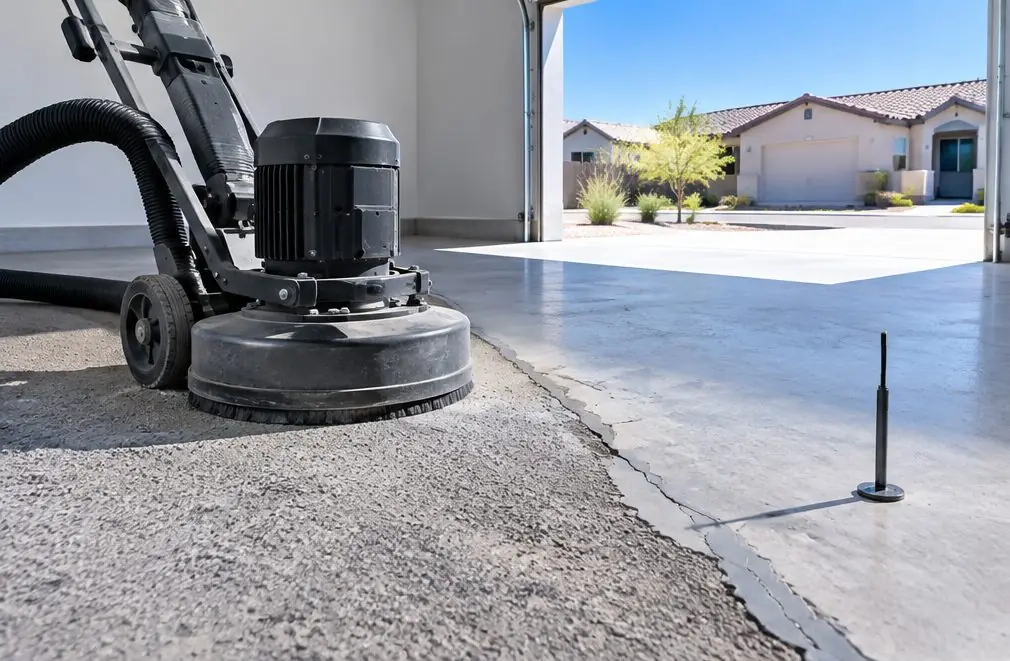
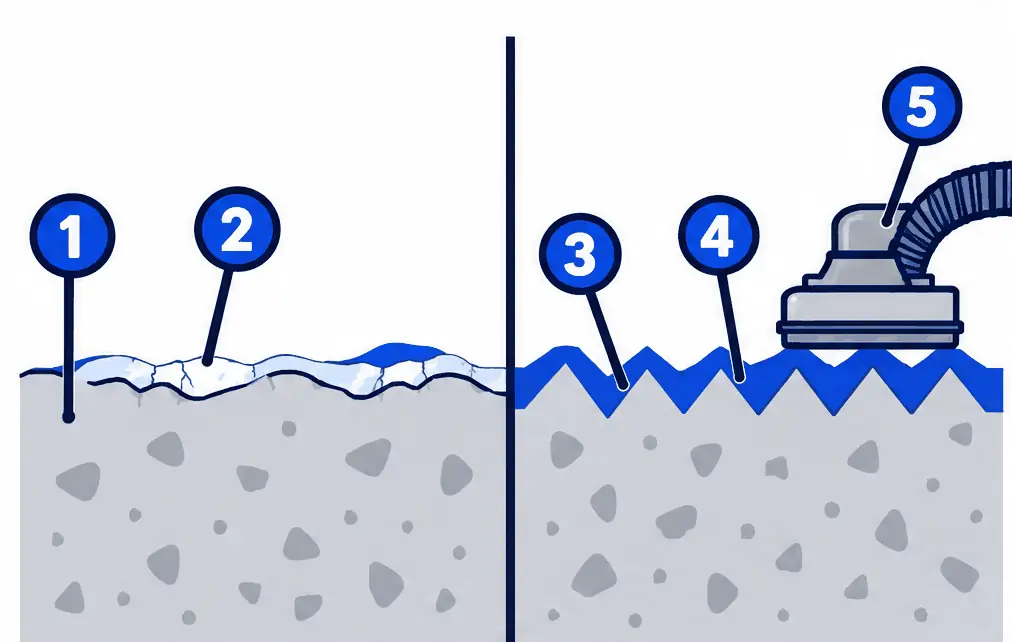
A diamond grinder with a dust shroud and a vacuum removes the weak top skin of the concrete and leaves an even, rough profile. A coating bonds to that profile. Acid etching is a weaker substitute: it leaves a shallower grip and cannot remove a curing compound, an old sealer or oil that has soaked in.
Prep is where a lot of the quoted price goes and where a lot of failures begin. A quote that says only "prep floor" is hard to compare. One that says "diamond ground to a rough profile, vacuumed twice" is not.
What the numbers show
- Etched surface Acid leaves a shallow, uneven texture.
- Loose film Laitance or old sealer can remain and lift with the coating.
- Ground surface A grinder cuts an even run of peaks and valleys.
- Coating in the profile The first coat fills the valleys and holds on the peaks.
- Shroud and hose The dust shroud and vacuum hose keep grinding dust out of the air.
How a young slab gets tested
A slab with moisture vapor coming up through it can push a coating off. Makers of coatings advise waiting 28 days for new concrete, and up to 60 in some conditions, but age alone does not settle it. A slab can be cured and still hold too much moisture.
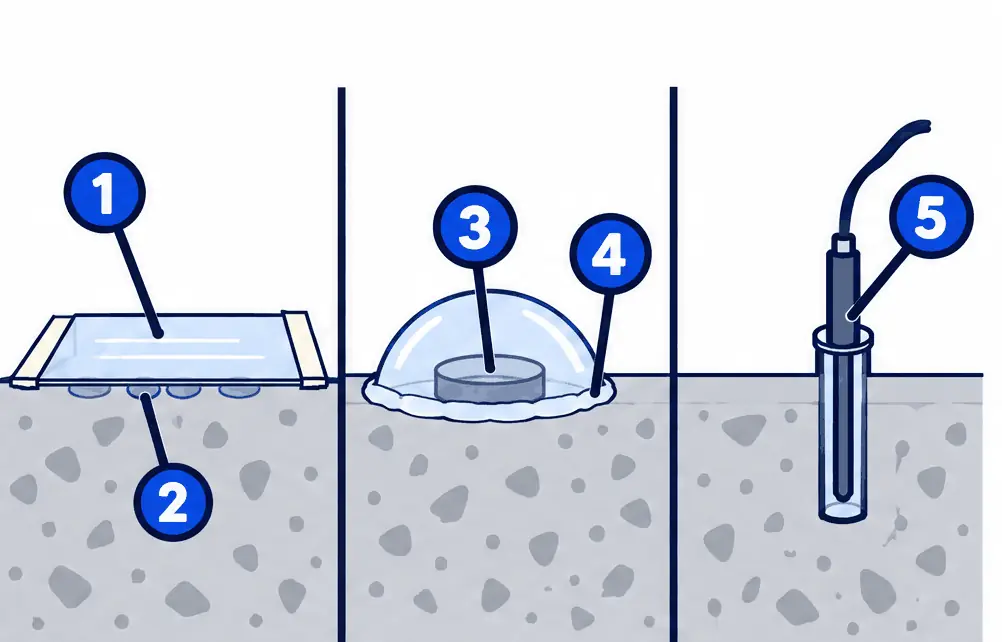
- Calcium chloride test (ASTM F1869): a sealed dish on the floor measures vapor over several days.
- In-slab relative-humidity probes (ASTM F2170): described as the most accurate reading, since they measure inside the concrete.
- The result against the system. The coating being installed sets the moisture level it tolerates, so the data sheet decides.
- If the reading is high: a moisture-mitigating primer is used, the job waits, or the plan is reconsidered.
Ask for the result on the quote, with the test named.
What the numbers show
- Plastic sheet A square of plastic taped on every edge and left in place for a day or more.
- Droplets Moisture on the underside of the sheet or a dark patch means vapor is rising; it is a first look, not a reading.
- Calcium chloride dish A weighed dish of salt under a sealed dome; the weight it gains measures vapor leaving the slab.
- Sealed dome rim The rim is sealed so only the slab's own vapor reaches the dish.
- In-slab probe A probe in a sleeve inside a drilled hole reads the humidity within the concrete.
Cracks, joints and chips
- Hairline shrinkage cracks are routed or ground open slightly, filled with a flexible or rigid filler and ground flush.
- Wider cracks and chips are cleaned out and patched with a repair mortar or epoxy paste, then ground level.
- Control joints are saw cuts made when the slab was poured. They are usually left as joints and filled with a joint filler, not covered with rigid coating, because the slab keeps moving.
- Spalls (edges and surface pieces that have broken off) are chipped back to sound concrete and patched.
Cracks are filled and ground flush; a moving crack can show again. No repair stops one from reappearing, and a quote should not promise otherwise.
What prep adds, by garage size
Typical Clovis add-ons per square foot, from the estimator, shown on a flake epoxy floor:
| Garage | Minor cracks, pitting (+$1–$2) | Old coating removed (+$1–$3) | Heavy oil or damp slab (+$2–$4) |
|---|---|---|---|
| 1-car, 240 sq ft | $240–$480 | $240–$720 | $480–$960 |
| 2-car, 400 sq ft | $400–$800 | $400–$1,200 | $800–$1,600 |
| 3-car, 700 sq ft | $700–$1,400 | $700–$2,100 | $1,400–$2,800 |
Added to a flake floor of $5–$8 per square foot, a 400-square-foot garage with minor cracks comes to $6–$10 per square foot, or $2,400–$4,000. Many cracks add a flat extra of its own. Market estimates, not quotes.
Cleaning up before the primer
Valley dust is fine and gets everywhere. Anything that settles in a wet primer or base coat stays in it. The garage is vacuumed after grinding, wiped down, and the door is kept open only as much as air requires. Installers who work in the early morning also have less wind and less dust in the air.
Before the primer goes down, the installer reads slab temperature and dew point. A warm slab on a hot day means waiting for a cooler hour.
Garage Floor Prep and Crack Repair — common questions
Why is a young Clovis slab tested for moisture before coating?
A slab can be past 28 days and still release vapor, which can lift or blister a coating. A calcium chloride test or in-slab humidity probes show whether the reading suits the system being installed.
Is acid etching enough to prepare a garage floor?
Usually not. Etching leaves a shallower grip than diamond grinding and cannot remove sealers, curing compounds or soaked-in oil, which is why grinding is the standard in a quote.
Garage Floor Prep and Crack Repair: check availability and price range
Bookings aren't open yet — a typical Clovis range in about 30 seconds.