
Warehouse Floor Coating in Clovis
Epoxy Floors Field Clovis covers floor coatings for warehouses and light-industrial buildings in Clovis — racking aisles, loading aprons, roll-up door thresholds and equipment corners — including multi-tenant units in the business parks along Herndon Avenue and Highway 168 and older industrial space near the airport.

Bookings aren't open yet. Leave your name and number; your message is recorded, and you'll get one message when a local installer is available.
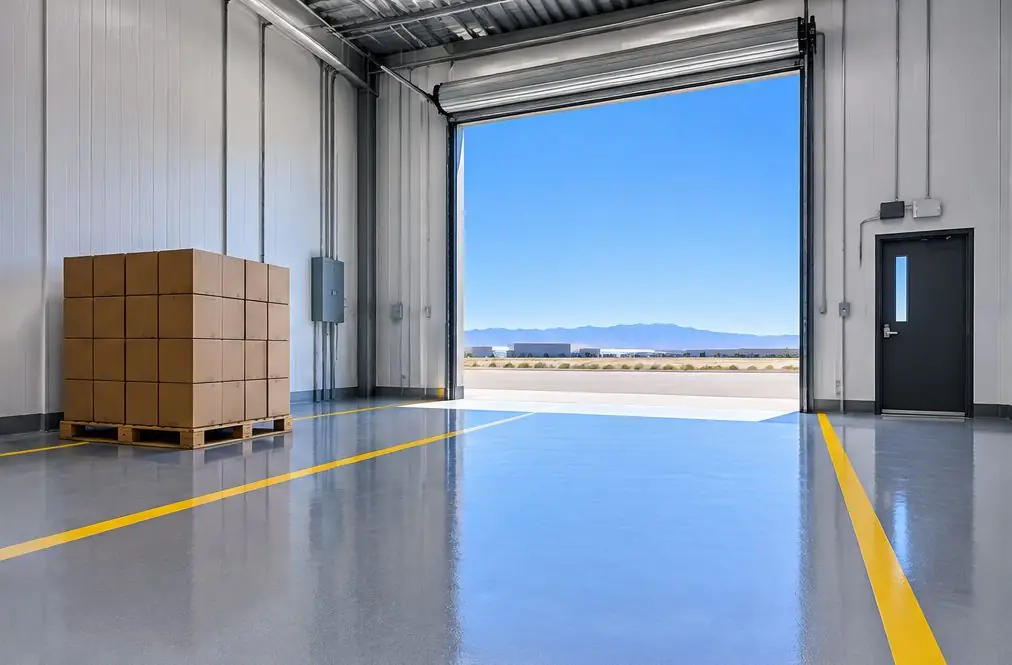 Illustration
Reading the floor plan lane by lane
Raw concrete sheds fine dust that settles on stock, and it soaks up whatever leaks from a jack or a pallet. A coating seals the face of the slab, but a lane crossed by hand trucks asks for something different from a lane crossed by loaded forklifts.
| Lane or area | Loads and wear | System a contractor might propose | Estimator range per sq ft |
|---|---|---|---|
| Racking aisle | Pallet jacks, steady loads | Solid-color epoxy with grit | $3–$7 |
| Forklift turning lane | Hard wheels braking and pivoting | Quartz-filled broadcast | $8–$15 |
| Dock door and apron | Impact, tire marks, sun at the opening | Quartz broadcast | $8–$15 |
| Battery charging corner | Possible electrolyte spills | A system whose chemical chart has been read for it | Quoted per project |
| Pack bench, office, break room | Foot traffic, rolling chairs | Decorative flake or solid with a satin top coat | $6–$12 |
Where Clovis warehouses sit
Industrial and flex space in Clovis is spread over several parks. Dry Creek Business Park lies north of Herndon Avenue between Minnewawa Avenue and Highway 168; its 2016 expansion added 44 lots on about 30 acres with a $3 million city investment, and the source lists no particular uses. A city notice describes a 153-acre expansion of the Clovis Research & Technology Park between Temperance and Nees Avenues for manufacturing, assembly and research, which is a plan on paper, not a finished fact. Yosemite Business Park, on Pontiac Way near the airport, is a multi-tenant industrial complex of four buildings, about 116,690 square feet and built in 1985.
A building from 1985 and one from a recent phase call for different questions. An older slab may have a sealer or curing compound on top, saw cuts that have opened over the decades and patches from dock changes; a young slab raises the moisture question below.
Roll-up doors in a 97-degree month
In July the mean high in Clovis is 97°F, and a loading apron that faces west can bake long before the afternoon shift. Hot air and a hot slab shorten the working time of fast-curing products and can trap bubbles as the slab warms and gives off air. Contractors plan door zones for first light, shade the opening where they can, and ask what slab temperature range the data sheet allows. Epoxy can amber in sunlight, so the strip in the sun is where a more UV-stable top coat is weighed.
Ask how slab temperature is measured on the day, rather than relying on the forecast. A reading is a fair line to write into a quote.
Young slabs and polished concrete
A tilt-up building poured recently may have a slab that looks dry and still is not. Manufacturers advise at least 28 days for new concrete and up to 60 in some conditions; age is only a start, and an in-slab relative-humidity test is called the most accurate. The system being installed sets the moisture level it tolerates.
Some owners ask about polishing the slab instead. Polishing grinds and hardens the surface and leaves no film to peel; a resin coat seals the surface against oil and is easy to recolor. Heavy fluid exposure favors the coat, and a plain concrete look with little exposure favors polishing. This page does not rank them.
Saw cuts, joints and the lines they draw
Slabs are cut so they crack where the builder intended. A rigid film laid across a moving joint tends to crack above it, so saw cuts are cleaned out, filled with a flexible filler and the coating is cut at the line. The estimator lists joint filling as a flat option of $400–$1,200.
| Joint | What it is | If it is ignored |
|---|---|---|
| Control joint (saw cut) | A planned crack line | The coating splits along it |
| Construction joint | Where two pours meet | Edges chip under wheels |
| Random slab crack | An unplanned split | It moves, so it can show again after repair |
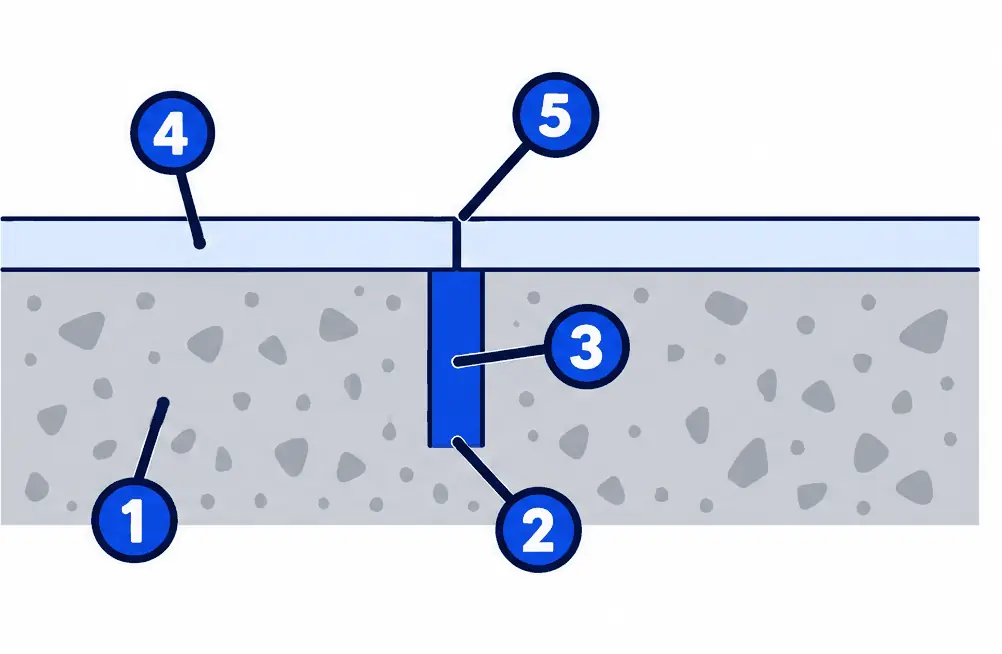
What the numbers show
- Concrete slab Joints are cut so shrinkage cracks follow straight lines.
- Saw-cut joint Made after the pour, about a quarter of the slab depth.
- Joint filler A flexible filler brought flush so wheels do not chip the edges.
- Coating Continuous on both sides of the joint.
- Cut in the coating A thin cut through the film right above the joint lets the slab move without tearing the coating.
A budget for aisles, a dock and a lane plan
A hypothetical 5,000-square-foot aisle area in solid epoxy with grit costs $15,000–$35,000 at $3–$7 per square foot, and joint filling adds $400–$1,200, for $15,400–$36,200. A separate 800-square-foot dock apron in quartz broadcast at $8–$15 per square foot costs $6,400–$12,000. Lane striping adds $300–$900 as a flat option.
| Zone (hypothetical) | Area | Calculation | Total |
|---|---|---|---|
| Aisles, solid epoxy with grit | 5,000 sq ft | $3–$7 per sq ft, plus joint filling $400–$1,200 | $15,400–$36,200 |
| Dock apron, quartz broadcast | 800 sq ft | $8–$15 per sq ft | $6,400–$12,000 |
| Lane striping | one floor | flat option | $300–$900 |
Market estimates, not quotes. Oil-soaked areas, an old coating or cracks add their own surcharges in the estimator. The lane plan is drawn before coating so the base color suits the marks: a pale base shows tire marks and a very dark one shows dust.
Warehouse Floor Coating — common questions
Is polished concrete or an epoxy coating better for a Clovis warehouse?
They answer different needs. Polishing hardens the slab itself and has no film to peel; epoxy seals against oil and can be recolored. Heavy leaks favor the coating, and a bare concrete look with few spills favors polishing.
Can forklifts drive on a coated floor?
On systems built for it, after the cure time on the data sheet. Thin garage-grade coatings are not made for hard forklift wheels.
Does this cover food packing and processing plants?
No. Plants inspected by federal food regulators follow their own regulators. This page is for private warehouse and light-industrial floors.
Warehouse Floor Coating: check availability and price range
Bookings aren't open yet — a typical Clovis range in about 30 seconds.