
Worked case: a three-car flake epoxy garage on a young tract slab in Harlan Ranch, custom blend and moving included — what happens and what it costs
Epoxy Floors Field Clovis walks through a typical job for a three-car garage in a northeast Clovis tract: a sound slab of about 700 square feet that is only months old, a moisture check before anything is mixed, a flake epoxy floor in a custom blend and a day set aside to move the contents out and back.
Bookings aren't open yet. Leave your name and number; your message is recorded, and you'll get one message when a local installer is available.
Worked example. The pictures are AI concept illustrations, not photographs; no installation was performed or arranged through this site; prices are typical Clovis area market ranges, not quotes.
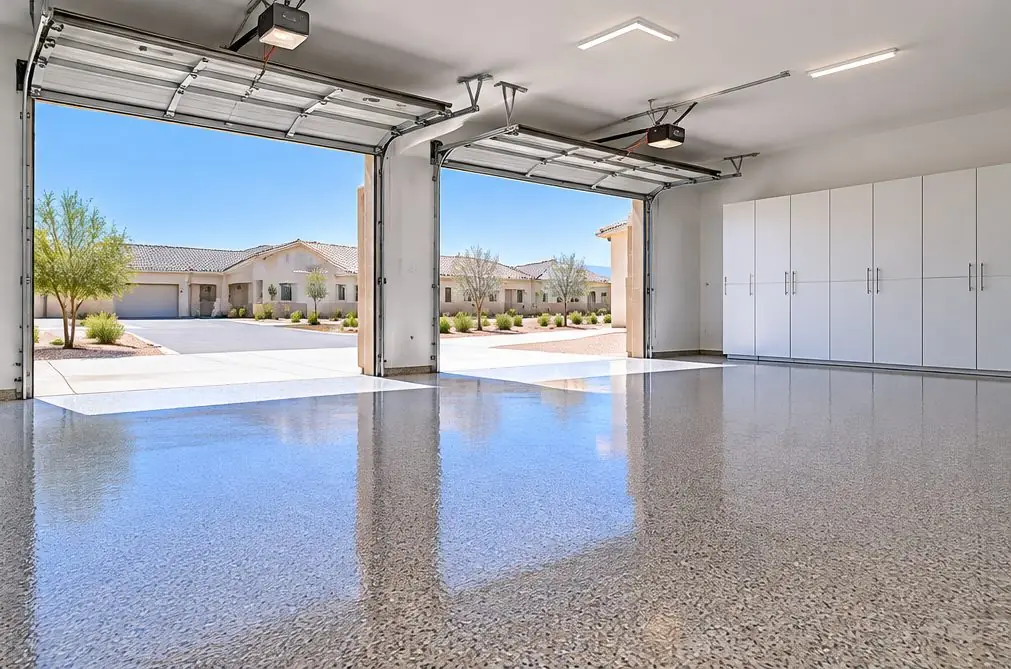 Illustration
Project Examples & Typical Prices
The scenario
Picture a three-car garage of about 700 square feet in a tract house in a planned northeast neighborhood. The slab is smooth, troweled by the builder and free of old paint, with a few hairline cracks that follow the saw cuts. A shiny film in places suggests that a curing compound was rolled on after the pour. The family moved in recently, and the garage is already full of boxes, bikes and a freezer.
The owner wants a quiet speckled floor in gray and tan to go with the cabinets and asks the question every new-slab owner asks: how soon is soon enough. Manufacturers commonly advise at least 28 days after the pour and, in some conditions, up to 60. They also say the moisture reading matters more than the calendar, and that the system being installed sets the level the slab may read.
The starting conditions at a glance:
- Size: three-car garage, about 700 square feet
- Slab: sound and young, hairline cracks only, a builder sealer on part of the surface
- System: full-broadcast flake epoxy in a custom blend with a clear top coat
- Setting: a July mean high near 97°F, so the day starts early
What the job involves
- The installer asks when the slab was poured and whether the builder applied a sealer, then takes a reading with a calcium chloride kit or in-slab humidity probes and compares it with the limit on the chosen system's data sheet.
- The household empties the garage the day before, or a flat-priced moving line covers it; the freezer is the last item out, since it needs a plug elsewhere.
- A diamond grinder tied to a vacuum removes the builder's film and opens the surface; the hairline cracks are routed, filled and ground flush.
- The base goes down at first light while the slab is cool, because the air by noon is hot enough to shorten the working time of the resin and the warm concrete can push air up into the coat.
- Flakes from the custom blend are thrown by hand into the wet base until it is covered; the next day the loose ones are scraped off and a clear top coat is rolled over the rest.
- The product data sheet sets the day for feet and the later day for the cars, which park on the driveway until then.
Materials and prep
- Calcium chloride kit or in-slab relative humidity probes, plus a slab thermometer
- Diamond floor grinder with a shroud, a vacuum and a hand grinder for the edges
- Epoxy primer, pigmented base coat, a flake blend mixed to the owner's palette and a clear top coat
- Notched squeegee, roller covers, a flake bucket, spiked shoes and fans
- Painter's tape for the door threshold and the baseboards
What it typically costs in the Clovis area
| Flake (chip) epoxy, full broadcast, 700 square feet installed ($5–$8 per sq ft) | $3,500–$5,600 |
| Custom flake blend | +$100–$300 |
| Move the garage contents out and back | +$150–$400 |
| Typical total | $3,750–$6,300 (market range, not a quote) |
These are typical local ranges, not a quote or an offer; an installer prices the actual job after seeing the floor.
Add-ons often paired with this job
- Coat the stem wall (the low wall around the garage) — +$150–$400. Coating the low wall around the room in the base color gives the perimeter a finished line.
- Coat the entry steps or landing — +$100–$300. The step up to the house door can be covered with the same stack.
- Extra crack or joint repair (many cracks) — +$150–$450. If the saw-cut hairlines turn out to be a network, a separate flat line pays for the added routing.
Why it is done this way
Flake suits a young slab for two reasons. The broadcast hides the small flaws a builder-troweled surface still shows after grinding, and it gives the top coat some tooth. At $5–$8 per square foot, it is also the least expensive of the systems that look finished, and over 700 square feet the base alone comes to $3,500–$5,600.
The wait is where a new tract slab differs from an old one. Concrete can pass 28 days and still hold too much moisture for a coating, so in-slab humidity probes, called the most accurate test, are worth asking about. A reading above the system's limit moves the plan toward a vapor-barrier primer, which is the damp-slab line in the estimator, or toward more time.
Two flat lines complete the quote. The custom blend adds $100–$300, and the moving line adds $150–$400 for emptying and refilling a three-car garage. Together with the base, they give the $3,750–$6,300 range.
A coated floor can be slippery when wet or oily. Broadcast flake and a fine grit added to the top coat add texture and grip; a heavier grit adds more grip and is harder to clean.
The alternatives that were weighed and set aside:
- Polyaspartic flake at $6–$10 per square foot shortens the return time and resists UV better, which matters more for a garage whose door faces the afternoon sun.
- A garage kit costs less but needs a rented grinder and gives a thinner film.
What would change the price
- A moisture reading over the system's limit adds the damp-slab line of $2–$4 per square foot or a longer wait.
- A slab with more than hairline cracks adds the minor-crack line of $1–$2 per square foot.
- Dropping to two cars cuts the floor to about 400 square feet, so each per-square-foot line gets smaller in proportion.
- A start pushed to a hot afternoon forces smaller batches and a faster crew.
- Stem walls, steps and moving the contents are flat add-ons.
Where this leads
- Service page: Flake Epoxy Garage Floors — The speckled finish that hides small slab flaws, with a first-light schedule for a 97-degree July and a price table for one-, two- and three-car garages.
- Local page: Epoxy garage floors in Harlan Ranch
- All services and typical prices: epoxy garage floors in Clovis
- More worked examples: Project Examples & Typical Prices
Check availability and the price range for this setup
Bookings aren't open yet — a typical Clovis range in about 30 seconds.