
Flake Epoxy Garage Floors in Clovis
Epoxy Floors Field Clovis covers flake (chip) epoxy garage floors across Clovis — the speckled finish that hides small slab flaws — in the two-car and three-car garages of the newer northeast neighborhoods and in older garages near Old Town, with the work timed around Central Valley summer heat.

Bookings aren't open yet. Leave your name and number; your message is recorded, and you'll get one message when a local installer is available.
 Illustration
What the chips do, and what they leave to the slab
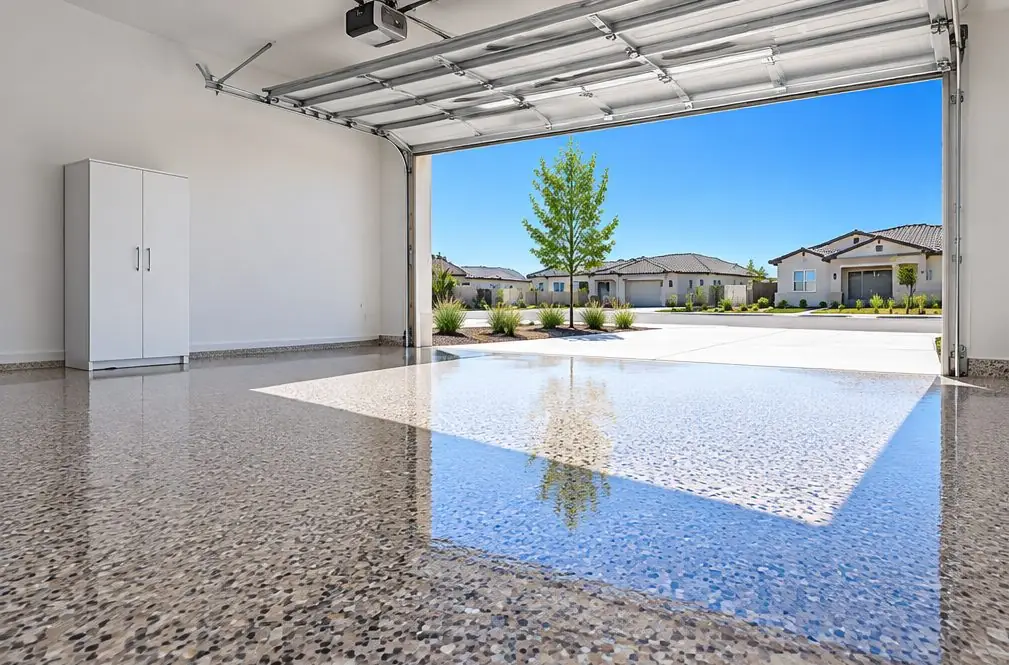
Flake epoxy has three layers that people tend to blur together: a pigmented base coat, a scatter of colored chips thrown into it while it is wet, and a clear top coat over the chips. The chips are what you see. They hide pits, patches and trowel marks, and they leave a texture you can feel underfoot.
Clovis has 43,954 housing units and roughly two in three occupied homes are owner-occupied (64.0% at the 2020 census), so a large share of the garages in town belong to people who plan to stay a while. For them the question is less "what looks good on day one" than "what still looks fine after years of tires, bikes and a dusty driveway".
What the numbers show
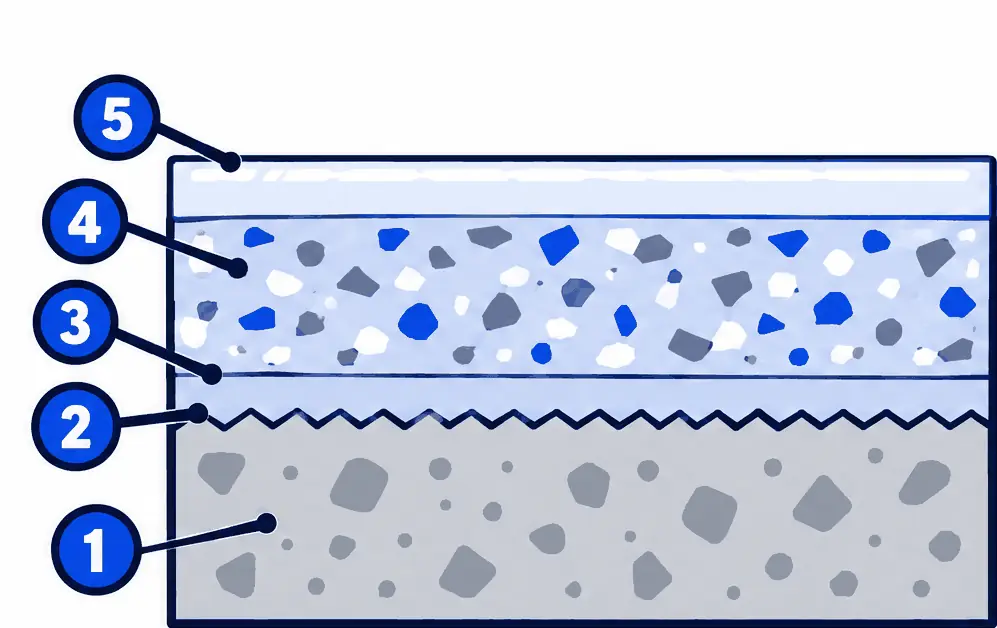
- Concrete slab The structure under everything; the coating adds color and wear, not strength.
- Ground surface A diamond grinder leaves an even rough texture for the primer to bite into.
- Primer Wets the opened surface so the base coat can bond to it.
- Epoxy base and flake Chips go into the wet base by hand and end up embedded with their tops showing.
- Clear top coat Seals the chips, smooths the surface and carries the wear.
Picking a blend that copes with valley dust
Fine dust blows into open garages here, and oil drips from the car show up on any color. The blend decides which of the two you notice first.
- Light tan and cream blends show oil spots and tire marks, and hide pale dust.
- Dark charcoal and brown blends hide oil and show a dusty film within days.
- Three-to-five tone gray and tan mixes break up both, and are the usual choice for a garage that gets swept once a week.
- Small chips sit flat and sweep easily; large chips make a bolder pattern and catch a little more dust between them.
A sealed floor is easier to sweep than bare concrete, and a smooth top coat over the chips is easier still. Look at the sample board once in the daylight at the open door and once under the garage lamps; the two rarely agree.
A summer job from first light to evening
With July highs averaging 97°F and August 95°F, the slab, the air and the product all run warm by afternoon. A day built around the cool hours looks something like this. It is general practice, not a schedule for any one job.
| Time of day | What usually happens | Why it sits there |
|---|---|---|
| First light | Dust is vacuumed, slab temperature and dew point are read | The slab is at its coolest |
| Early morning | Primer and the pigmented base coat go down | Fast-cure products have more working time before the heat builds |
| Mid-morning | Chips are broadcast into the wet base by hand | The base must still be wet to take them |
| Midday | Pause; loose chips are scraped and swept once the base has set | A hot slab shortens working time and can bubble a coat |
| Late afternoon or evening | Clear top coat, once the slab has cooled inside the data sheet's range | Rolling it at noon is where lap marks and pinholes come from |
Have the quote spell out the planned start time; the answer shows how the installer deals with Clovis heat.
Flake costs for 240, 400 and 700 square feet
Typical Clovis ranges for full-broadcast flake epoxy on a sound slab, from the estimator ($5–$8 per square foot):
| Garage | Floor area | Typical total |
|---|---|---|
| 1-car | 240 sq ft | $1,200–$1,920 |
| 2-car | 400 sq ft | $2,000–$3,200 |
| 3-car | 700 sq ft | $3,500–$5,600 |
One home-services price guide for Clovis puts epoxy in general at $6–$9 per square foot, overlapping the upper part of this range. Slab condition shifts the rate: minor cracks or pitting +$1–$2, an old coating to remove +$1–$3, a damp or oil-soaked slab +$2–$4. Stem wall and entry steps are flat extras. Market estimates, not quotes.
Slabs from the northeast tracts and the older streets
A garage in a neighborhood such as Harlan Ranch or Loma Vista may sit on a slab that is only months old. A 2004 city notice describes the Harlan Ranch plan at 1,832 residential units, and a later city council approval covered about 1,174 houses near Ashlan and Leonard Avenues; both are reminders of how much concrete in town is recent. A builder's curing compound or clear sealer may still be on the surface. It is ground off before coating, because a coat laid over it can let go.
Coating makers advise letting new concrete cure for 28 days at minimum, longer in some conditions, up to 60. In-slab humidity probes tell you more than a calendar can. Slabs near Old Town were poured in earlier decades and bring other surprises: oil that soaked in over the years, patched cracks and old paint.
On a street with a homeowners association, the CC&Rs sometimes touch contractor parking, work hours and an open garage door. The association decides what applies; a short note to its management company costs nothing.
Three lines that separate two flake quotes
- Coverage. Full broadcast covers the base completely; partial broadcast leaves color showing through. The quote should say which.
- Film. Primer, base and top coat each named, with mils of thickness, instead of a vague "two coats of epoxy".
- Heat plan. A start time, how the slab temperature is read and the date a car may return.
When two quotes sit a dollar apart per square foot, the gap often hides in one of these three lines.
Flake Epoxy Garage Floors — common questions
Does a Clovis summer change how flake epoxy is installed?
It does. Heat shortens working time and can make a coat bubble as the slab warms, so installers tend to start at first light and save the top coat for a cooler hour. The data sheet gives the real cure times for the day's temperature and humidity.
How much is flake epoxy for a three-car garage in Clovis?
About $3,500–$5,600 for 700 square feet on a sound slab, from the estimator at $5–$8 per square foot. Cracks, an old coating or a damp slab add to that, and the stem wall is a flat extra.
Flake Epoxy Garage Floors: check availability and price range
Bookings aren't open yet — a typical Clovis range in about 30 seconds.