
Auto Shop Floor Coating in Clovis
Epoxy Floors Field Clovis covers floors for repair shops, tire shops and hobby workshops in Clovis — service bays, lift areas, wash corners and front counters — in multi-tenant units on the airport side and in the business parks, with each zone matched to the fluids, tires and weights it meets.
Bookings aren't open yet. Leave your name and number; your message is recorded, and you'll get one message when a local installer is available.
 Illustration
The harshest spill picks the system
Engine oil, coolant, brake fluid and parts solvent all end up on repair-shop concrete, which drinks them in and keeps the stain. Sealing the face of the slab turns a soaked spot into a wipe-up. Every zone is matched to the worst thing it meets.
| Zone | Main stress | System a contractor might propose | Estimator range per sq ft |
|---|---|---|---|
| Open bay floor | Oil drips, creeper wheels, dropped wrenches | Solid-color epoxy with grit | $3–$7 |
| Lift footprint | Concentrated loads from steel baseplates | Quartz-filled broadcast, sound slab only | $8–$15 |
| Wheel and tire area | Warm rubber, scuffing | Quartz broadcast with a UV-stable top coat | $8–$15 |
| Wash corner | Water, soap, runoff to a drain | Urethane cement, or sealed epoxy | $10–$18 |
| Front counter | Customers walking in off the lot | Decorative flake | $6–$12 |
Hot tires, brake fluid and what the data sheet says
Hot-tire pickup — a warm tire lifting the coating — is mostly a prep and product problem; a ground slab and a system rated for it reduce the risk. Lot asphalt and bay concrete in the valley both hold the day's heat, so cars roll in warm and a thin or poorly adhered film is the first to show it.
Whether a coating tolerates a fluid is answered by a named product's chemical-resistance chart, checked against the fluids the shop uses and how long they sit. Brake fluid and strong solvents are hard on many resins, so a coating buys time to wipe, not immunity.
Grip, grit and cleaning
A coated floor can be slippery when wet or oily. Broadcast flake and a fine grit added to the top coat add texture and grip; a heavier grit adds more grip and is harder to clean. A bay mopped of oil every day sits at a different point on that scale than a customer lobby.
Keeping walking surfaces safe is the business's responsibility under Cal/OSHA. A contractor can supply the named product's published slip value and test method, and wet or greasy zones call for a heavier texture.
Shops on the airport side and in the business parks
Yosemite Business Park, at 110 W Pontiac Way near Fresno Yosemite International Airport, is described in a listing as a multi-tenant industrial complex of four buildings built in 1985. Slabs of that age may carry decades of spilled oil, old sealers, patched cuts for floor drains and cracks near anchor points. The listing names no tenants and this page makes no claim about any of them.
Summer heat sets the calendar. With July highs averaging 97°F and bay doors standing open, sun on the slab cuts the pot life of a fast-cure product, so the bay nearest the door is usually coated at first light. Shops with more than one bay can work in one while the other is coated and then trade places; the data sheet sets when each bay may take foot traffic and rolling tool chests. Dust blows through open doors, so a sealed floor, which is easier to sweep, helps but does not stop the dust.
Lift posts, anchors and the slab underneath
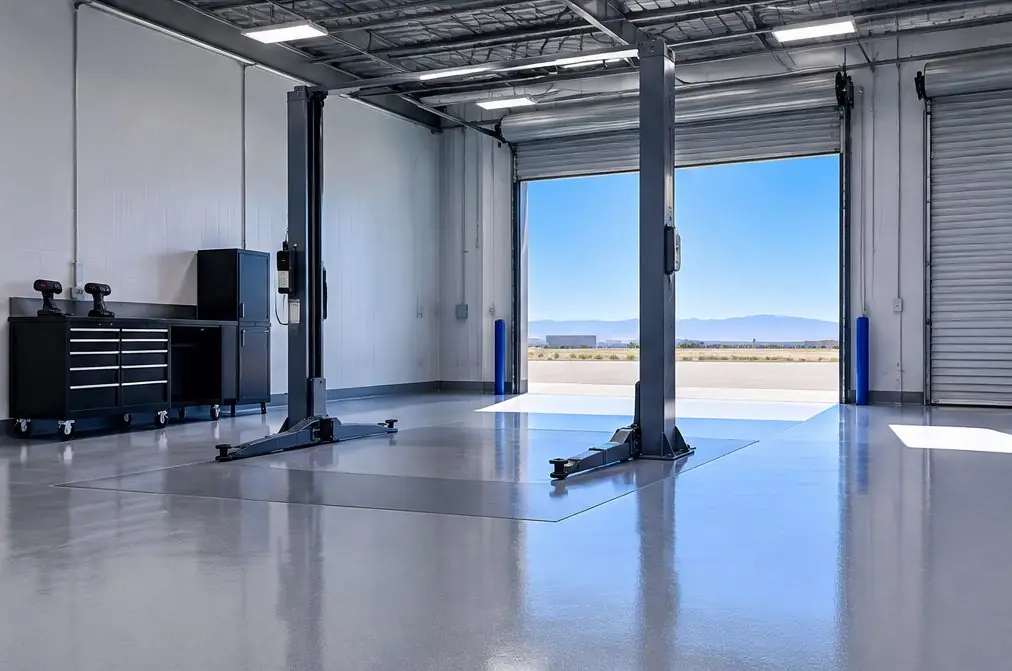
Two-post and four-post lifts are anchored into the slab, and resin on top adds no structure to concrete. If grinding exposes a crack that crosses the anchor pattern or a slab that looks thin, the finding goes in writing to whoever maintains the lift before any coating is mixed.
A three-bay shop as a sample
Take a hypothetical three-bay shop of 1,600 square feet whose slab is oil-soaked. Solid epoxy with grit at $3–$7 plus the oil and moisture surcharge of $2–$5 gives a rate of $5–$12 per square foot, or $8,000–$19,200. A 150-square-foot wheel and tire area in quartz broadcast at $8–$15 adds $1,200–$2,250.
| Part of the shop (hypothetical) | Rate per sq ft | Area | Total |
|---|---|---|---|
| Bays, solid epoxy with grit, oil-soaked slab | $5–$12 | 1,600 sq ft | $8,000–$19,200 |
| Wheel and tire zone, quartz broadcast | $8–$15 | 150 sq ft | $1,200–$2,250 |
| Both zones | 1,750 sq ft | $9,200–$21,450 |
These are market estimates and not quotes. Paint that has to be stripped first brings in the old-coating surcharge, $2–$4 more per square foot.
Auto Shop Floor Coating — common questions
Does brake fluid hurt a resin floor in a repair shop?
It can, because it attacks many resin systems. Check the named product's chemical chart against the fluids you use, and wipe spills soon.
Is it fine to coat the concrete beneath a lift?
Usually, if the slab is sound and has been tested. Because the film adds no structure, any crack near the anchors is looked at before work starts.
Auto Shop Floor Coating: check availability and price range
Bookings aren't open yet — a typical Clovis range in about 30 seconds.