
Epoxy Garage Floors in Old Town Clovis, CA
Epoxy Floors Field Clovis covers epoxy and commercial floors in Old Town Clovis, the railroad-era center around Clovis Avenue where restored storefronts and newer buildings in an early-1900s style stand side by side, so one block can hold an old slab and a recently poured one.
Bookings aren't open yet. Leave your name and number; your message is recorded, and you'll get one message when a local installer is available.
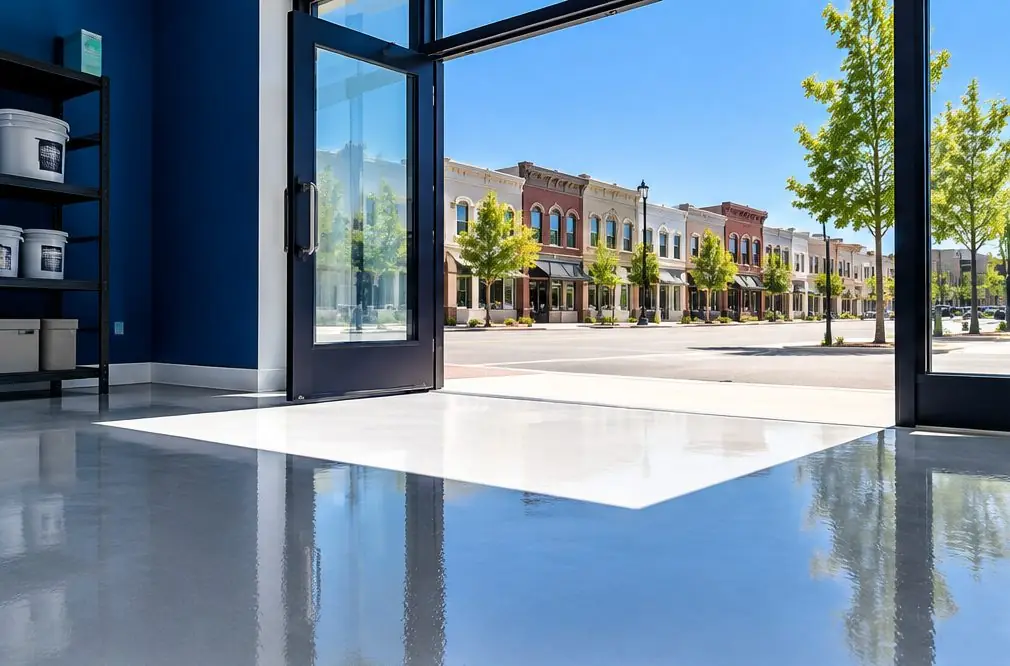
Storefronts on a railroad townsite
Clovis began as a freight stop on the San Joaquin Valley Railroad, which was organized in 1890; the townsite was mapped in December 1891 and the city incorporated in February 1912. The historic center has since been revived as Old Town Clovis: older storefronts along Clovis Avenue were restored, newer buildings were given facades in the style of the early twentieth century, and the street hosts festivals plus a weekly farmers' market on Friday evenings from mid-May to mid-September. The last railroad-built depot was moved in 1999 to the corner of Clovis Avenue and Fourth Street and restored. Most businesses here rent from a building owner, and the buildings are of very different ages.
At a glance:
| Factor | What to expect in Old Town Clovis |
|---|---|
| Buildings | A mix of restored older storefronts and newer infill, many with several tenants |
| Businesses | Cafes, restaurants, shops, salons, studios and small offices |
| Floors | Old slabs under tile, vinyl or paint; newer slabs in the infill buildings |
| Approvals | The building owner for any floor change; the county for a food facility |
| Typical systems | Urethane cement for kitchens, flake for shops and studios, gritted solid color for back rooms |
Garage and business floor coatings in Old Town Clovis
Old Town business owners ask about:
A kitchen in a restored building
Urethane cement runs $10–$18 per square foot in the estimator, and a coved base is its own line; an older slab is checked for damp spots before anything is poured.
A shop that closes only on its own schedule
Flake epoxy at $6–$12 per square foot suits a boutique or studio floor, and the work is usually split into zones so the doors can open on event days.
Whatever the last tenant left
Mastic, tile glue and thin paint come off first, and the estimator adds $2–$4 per square foot when an old coating has to be removed.
Old buildings, new paperwork
A kitchen remodel in Old Town starts with two sets of plans. The Fresno County Department of Public Health, Environmental Health does not receive plans until the plan check fee is paid, works through them in the order they arrive and answers with a correction letter or an approval letter. California food-facility rules call for floors that are smooth, durable, nonabsorbent and easily cleanable, with a coved base; the county's own construction checklist, not this site, lists the finish details it expects. The building owner is the second gate, and a lease usually asks for written consent before any alteration.
Epoxy floors in Old Town Clovis: questions
Can an Old Town shop keep trading during a floor job?
Often, by zones and after hours. The schedule is a flag in the estimator for the contractor and does not change the price range.
Who decides what a restaurant floor must look like in this district?
The Fresno County Department of Public Health, Environmental Health handles plan check and inspection for food facilities, and the building owner decides what a tenant may change. The kitchen page lists the questions to ask each of them.
Check availability and prices in Old Town Clovis
Bookings aren't open yet — a typical Clovis range in about 30 seconds.