
Worked case: a one-car solid-color epoxy garage in Loma Vista, hairline cracks repaired and the contents moved — what happens and what it costs
Epoxy Floors Field Clovis walks through a typical job for a one-car garage in a newer Loma Vista house: a recent slab of about 240 square feet with hairline shrinkage cracks, a plain gray solid-color epoxy with a fine grit in the top coat, an open door and a fan to move air in a small room and the contents moved out and back.
Bookings aren't open yet. Leave your name and number; your message is recorded, and you'll get one message when a local installer is available.
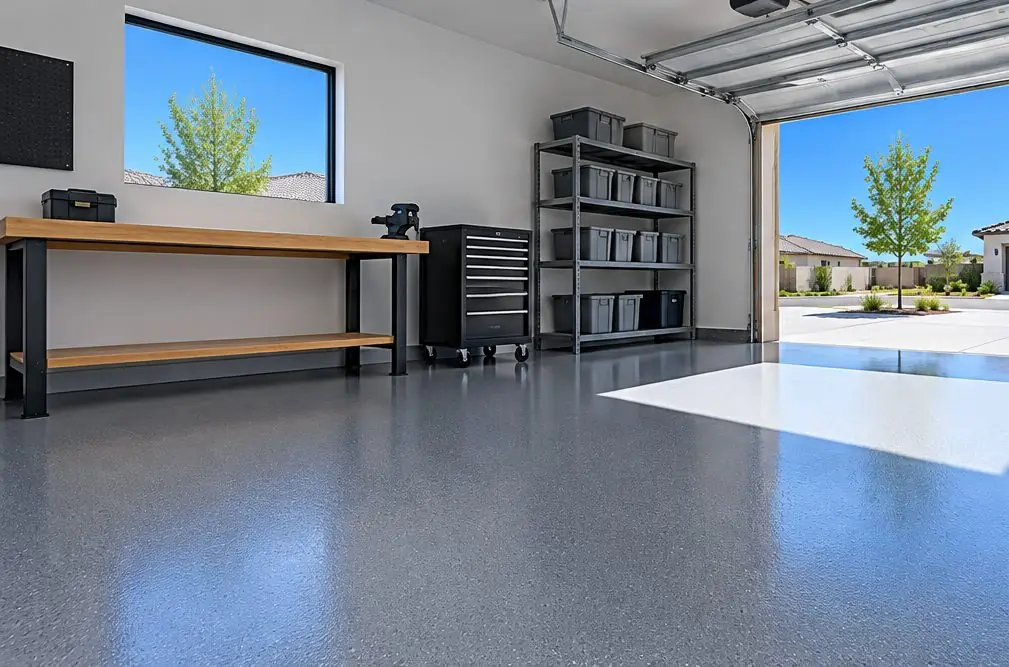
Worked example. The pictures are AI concept illustrations, not photographs; no installation was performed or arranged through this site; prices are typical Clovis area market ranges, not quotes.
 Illustration
Project Examples & Typical Prices
The scenario
Picture a one-car garage of about 240 square feet in a newer house in Loma Vista. The slab is a few years old and smooth. Fine hairline cracks cross it near the corner and one saw cut shows a small chip. The garage holds a bicycle, a shelf of paint cans, a lawn mower and a chest freezer, and the household uses it for a weekend workbench.
The owner wants one clean color that wipes up, no pattern and a modest total. A single color shows every ridge a grinder leaves and every patch, so the repair work matters more than the pigment. A fine grit in the top coat adds some grip at the door.
The starting conditions at a glance:
- Size: one-car garage, about 240 square feet
- Slab: recent, sound apart from hairline shrinkage cracks and one chipped saw-cut edge
- System: solid-color epoxy in medium gray with a fine grit in the top coat
- Setting: a small room, so ventilation matters, and a July mean high near 97°F
The owner has also noticed that the garage gets hot by early afternoon, because the door faces the late sun. That is a reason to plan a first-light start and to ask whether the primer and the base coat will be rolled before the slab warms. A smaller room can be finished in a single morning session, which suits the valley heat, but only when the grinding and the repairs were done the day before.
The neighbors have similar floors, a few of them with a hardware-store paint that wore off in the first summer. The owner's goal is practical: a floor that wipes clean, a color that does not show dust at once, and a surface that holds up to a bicycle stand and a folding ladder.
What the job involves
- A moisture check comes first even on a recent slab: a calcium chloride kit or an in-slab probe, since a leaking downspout or a high water table near the slab can leave it damp.
- The household clears the garage the day before; the lawn mower, bike and shelf go to the driveway or a spare room.
- A diamond grinder with a vacuum takes off the surface sheen and opens the concrete; the hairline cracks are routed, filled and sanded flush, and the chipped saw-cut edge is rebuilt.
- Primer and the gray epoxy are rolled in the early morning, with the door fully open and a fan pulling air through, because fumes collect quickly in a room this size.
- A clear coat with fine grit is rolled over the cured color for grip at the door.
- The data sheet sets when feet and the car can return; the car stays on the driveway until then, and the household plans around the cure.
Materials and prep
- Moisture kit, slab thermometer and a dew point meter
- Compact floor grinder with a vacuum and a hand grinder for the edges
- Crack chaser, flexible filler, patch mortar and a sanding block
- Primer, pigmented epoxy, a fine grit additive and a clear top coat
- Rollers, a squeegee, spiked shoes, a box fan and painter's tape
What it typically costs in the Clovis area
| Solid-color epoxy, optional grit, 240 square feet installed ($3–$6 per sq ft) | $720–$1,440 |
| Minor cracks, pitting or small spalls (+$1–$2 per sq ft) | +$240–$480 |
| Move the garage contents out and back | +$150–$400 |
| Typical total | $1,110–$2,320 (market range, not a quote) |
These are typical local ranges, not a quote or an offer; an installer prices the actual job after seeing the floor.
Add-ons often paired with this job
- Coat the stem wall (the low wall around the garage) — +$150–$400. A coat on the low wall around the room matches the floor.
- Coat the entry steps or landing — +$100–$300. A single step to the house door can be coated in the same stack.
- Extra crack or joint repair (many cracks) — +$150–$450. If the cracks run the length of the room, a flat line pays for the added routing.
Why it is done this way
A solid color is the plain choice and the lowest-priced of the garage systems at $3–$6 per square foot. It takes tool drops and tire marks well, and it cleans with a mop. It also hides nothing, which is why the minor cracks line of $1–$2 per square foot is part of the estimate, bringing the rate to $4–$8 and the base to $960–$1,920 on 240 square feet.
A small garage keeps the same list of steps as a large one: a grind, crack repair, a moisture check, a primer, a coat and a top coat. The crew and the machines still come out for the day, so contractors often put a minimum charge on small floors, and the price per square foot should be read with that in mind.
Fumes concentrate in a small room, which is why the door stays open and a fan is placed in it. Early starts also help in the valley heat, since a warm slab shortens the working time of the epoxy.
A coated floor can be slippery when wet or oily. A fine grit in the top coat adds texture and grip; a heavier grit adds more grip and is harder to clean, so the amount is a choice between the two.
The size of the room changes how the day runs. With 240 square feet to cover, one person can roll the primer in a few minutes, so the real clock is the slab itself: the owner can ask when the garage was last wet-cleaned, whether a builder's sealer was ever brushed on, and whether a corner stays cooler than the rest at dawn. Those answers decide how long the grinder works and whether a spot primer goes down before the color.
A narrow one-car bay also means the walls are close. Roller splatter on the baseboard, a dusty garage-door track and a water heater against the back wall are the details that make a small floor look finished or sloppy, and they are worth naming in the quote as taped, cleaned or moved.
The alternatives that were weighed and set aside:
- Flake at $5–$8 per square foot hides the patches and costs more.
- Leaving the concrete bare costs nothing but leaves a surface that stains and dusts.
What would change the price
- A damp reading adds the line of $2–$4 per square foot and a vapor-barrier primer.
- Many cracks instead of a few hairlines add the flat extra-crack line.
- A two-car garage of about 400 square feet scales every per-square-foot line.
- A minimum job charge on very small floors can raise the low end of the range.
- Stem walls and steps are flat add-ons, as is moving the contents.
Where this leads
- Service page: Solid-Color Epoxy Garage Floors — The entry-level professional coating, one flat color with grit where grip matters, plus five questions that settle whether a kit is worth a Saturday in July.
- Local page: Epoxy garage floors in Loma Vista
- All services and typical prices: epoxy garage floors in Clovis
- More worked examples: Project Examples & Typical Prices
Check availability and the price range for this setup
Bookings aren't open yet — a typical Clovis range in about 30 seconds.