
Worked case: an 1,800-square-foot retail showroom floor in the Sierra Vista Mall district, joints filled and work in zones — what happens and what it costs
Epoxy Floors Field Clovis walks through a typical job for an 1,800-square-foot showroom in a retail unit near Sierra Vista Mall: a sound slab with open saw cuts, decorative flake epoxy, joint filling, landlord consent and work in zones so the store keeps selling during business hours.
Bookings aren't open yet. Leave your name and number; your message is recorded, and you'll get one message when a local installer is available.
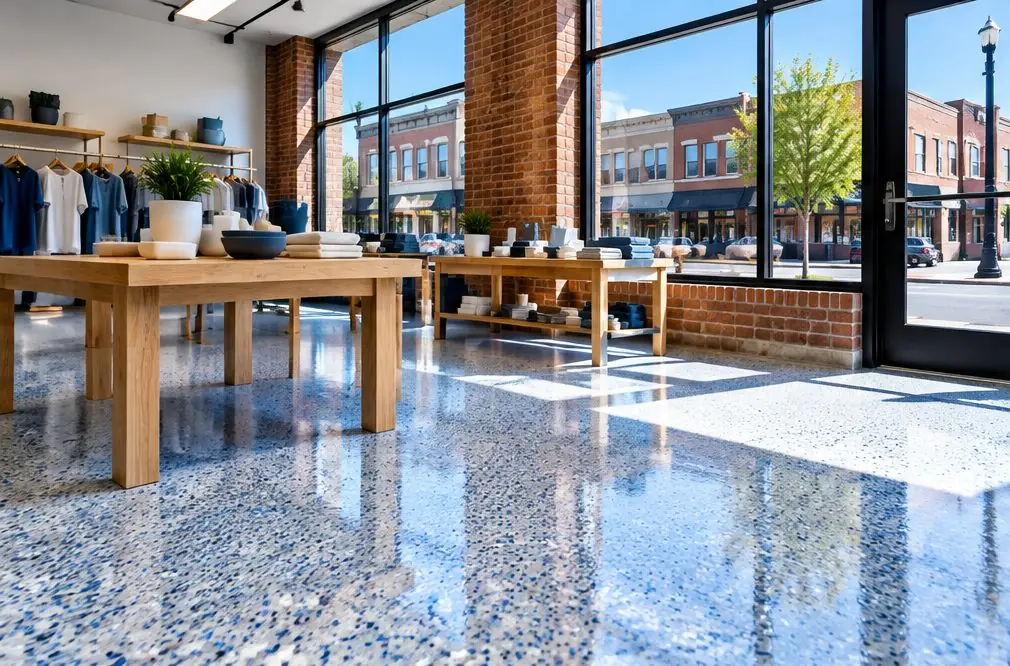
Worked example. The pictures are AI concept illustrations, not photographs; no installation was performed or arranged through this site; prices are typical Clovis area market ranges, not quotes.
 Illustration
Project Examples & Typical Prices
The scenario
Picture a furniture and home-goods showroom of about 1,800 square feet in a leased unit near the Sierra Vista Mall, a 78-acre enclosed regional shopping center. The floor is a plain slab that a previous tenant covered with a thin sealer, now scuffed along the main path from the door to the counter. Two saw cuts cross the room, and their edges have opened a little. Customers walk across the floor all day.
The owner wants a decorative flake in light gray and blue that photographs well and wipes up after a spill. The lease requires the landlord's written consent for changes to the floor, and the tenant obtains it before ordering material. Closing for a week is out of the question, so the floor is coated in sections while the store stays open.
The starting conditions at a glance:
- Size: about 1,800 square feet of showroom floor
- Slab: sound, a thin worn sealer, open saw cuts
- System: decorative flake epoxy with a clear top coat
- Schedule: sections during business hours, one half of the room at a time
Heads-up: The landlord's consent comes before the color samples, and the center's rules on loading and after-hours access narrow the schedule.
What the job involves
- The tenant sends the landlord a short packet naming the product, the dates, the work hours and where the equipment enters, and waits for written consent.
- The installer splits the room in two with a plastic wall and a floor-level sheet barrier so customers use one half while the other is open to the work.
- A grinder with a vacuum removes the worn sealer and opens the surface in the closed half; the saw cuts are cleaned and filled with a flexible joint material, and the coating is cut at each joint.
- A pigmented epoxy base is rolled in the morning, flakes are broadcast by hand to cover and the loose ones are swept away the next day.
- A clear top coat locks in the flakes; the data sheet sets the day when feet may cross and when display tables can go back.
- The barrier moves to the finished half and the process repeats, with fixtures shifted from one half to the other.
Materials and prep
- Floor grinder with a dust extractor and a hand grinder for the edges
- Flexible joint filler, a backer rod and a trowel
- Epoxy primer, pigmented base, vinyl flakes in the chosen blend and a clear top coat
- Plastic sheeting, floor protection, box fans and spiked shoes
- Squeegees, roller frames and painter's tape
What it typically costs in the Clovis area
| Decorative flake (chip) epoxy, 1,800 square feet installed ($6–$12 per sq ft) | $10,800–$21,600 |
| Joint filling (saw cuts and control joints) | +$400–$1,200 |
| Typical total | $11,200–$22,800 (market range, not a quote) |
These are typical local ranges, not a quote or an offer; an installer prices the actual job after seeing the floor.
Add-ons often paired with this job
- Line striping and safety markings — +$300–$900. Painted walking lanes or a marked queue at the counter are a flat line.
- Cove base up to 100 linear feet — +$1,500–$2,500. A coved base up the wall gives a finished look along the display walls.
Why it is done this way
Decorative flake is the common showroom pick because the broadcast hides small flaws, gives some texture and photographs well. At $6–$12 per square foot, the base on 1,800 square feet comes to $10,800–$21,600, and the joint-fill line of $400–$1,200 brings the total to $11,200–$22,800.
Joints decide how long the surface looks good. A rigid coating cannot bridge a moving saw cut, so each cut is cleaned and filled with flexible material, and the coating is cut at the line. Skip that step and a crack tends to follow the cut.
Working in halves is what keeps the doors open. The estimator's schedule flag marks the job for the contractor; it does not change the range, but it does stretch the number of days. Foot traffic and the return of fixtures depend on the product's data sheet at that day's temperature.
A coated floor can be slippery when wet or oily. Broadcast flake and a fine grit added to the top coat add texture and grip; a heavier grit adds more grip and is harder to clean. Near the entrance, grip counts for more than easy cleaning.
The alternatives that were weighed and set aside:
- Quartz broadcast at $8–$15 per square foot wears better under heavy carts and costs more.
- Vinyl plank is a different trade with seams to maintain.
What would change the price
- A sealer thicker than assumed or an old adhesive adds the old-coating line of $2–$4 per square foot.
- Cracks beyond the saw cuts add the repair line of $1–$3 per square foot.
- A damp reading adds the line of $2–$5 per square foot.
- A stricter landlord schedule, such as nights only, changes the number of days and the labor.
- Cove base, striping and joint filling are flat options.
Where this leads
- Service page: Retail and Showroom Epoxy Floors — Floor finishes for Old Town shop fronts and the stores around Sierra Vista Mall, with notes on glare, old slabs and working around opening hours.
- Local page: Epoxy garage floors in Sierra Vista Mall district
- All services and typical prices: epoxy garage floors in Clovis
- More worked examples: Project Examples & Typical Prices
Check availability and the price range for this setup
Bookings aren't open yet — a typical Clovis range in about 30 seconds.